Thursday, December 16, 2021

Abelardo Morell


Abelardo Morell is a Boston-based photographer that was born in Havana Cuba in 1948. Morell is best known for his work with camera obscura. 


I find this image of his particularly interesting. I appreciate that he combined the outside work with the indoors. This is a concept that I haven't seen much. I like that he chose to use a mostly empty room with only a desk, a chair, and a clock. With that choice, the reflection of the city is more apparent. If he had chosen a more busy setting, the image would have looked cluttered. The way the top of the city lines up with the top of the furniture shows artistic expertise and that he spent time to gets this photo to work. I think that the contrast of the city in whites and greys goes nicely with the silhouetted furniture. I am impressed that he was capable of getting all of the buildings from the outside, that makes the image look complete. If the buildings were on the ceiling, it would have taken away from the image. I think that overall, this image is very well done, and my favorite of his work. 

Monday, April 19, 2021

Nikki S. Lee


Nikki S. Lee was born in 1970 in Geochang-gun, South Korea. She went to New York University, Chung-Ang University Anseong Campus, and Fashion Institute of Technology. She was well known for her work that involved attempting to assimilate into different social and subcultural groups. Different groups included: young punks, senior citizens, yuppies, and hip-hop fans. She would do this by mimicking their styles and mannerisms. 


This photo is from Lee's Hip Hop Project. I think that this image is interesting because the depiction of "Hip Hop" can be seen through the subjects' fashion. The sunglasses and use of chains as necklaces and belts screams Hip Hop to me. The way the people are posing also seems to represent Hip Hop. All of their faces are nonchalant as if they're purposely not smiling, not trying to look happy. They look more dramatic than anything. I think the way that we can see a front car seats changes how a person views the image as well. I find it interesting that she chose to photograph them in a car, I'm guessing this is a choice Lee made, seeing as how the subjects are posing. It makes me wonder if a different setting could have gotten the point of "Hip Hop" across. Personally, I would have gone for a background of street art. 

Thursday, April 8, 2021

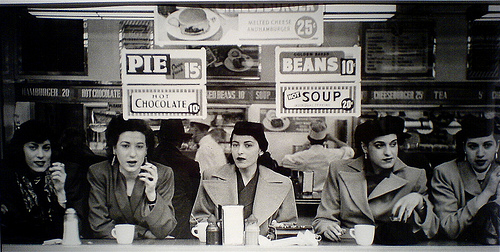
Robert Frank


 Robert Frank was a swiss photographer that was well known for photographing an outsiders view of America. He was born in Zürich, Switzerland on November 9th, 1924. He died in Inverness, Canada on September 9th, 2019. 

This image is from Frank's book The Americans. A reoccurring theme throughout the book is the use of American flags, and I don't care much for the flag as an American, so I decided to go with a more subtle image. I really like this one because all of the identifiable people in the image are women. Knowing that this series was taken in the 1950's, I would not expect women to be in the forefront of an image. The way they are lined up and the posture each person holds signifies empowerment. Each woman is also holding a different facial expression, but they all seem to be confident. This image appears to be candid, almost as if the women wouldn't stop what they were doing for a photographer. That makes me think that they were expressing that they value their time. I think that this image is a symbol of women's empowerment even if they were still treated as lesser than men. 


Tuesday, March 30, 2021

Magnum Photography


 Cornell Capa followed John. F. Kennedy around his campaign trail in the 1960’s.  This is an image from the Magnum photos website (magnumphotos.com) 

This photo is Kennedy accepting his nomination at the Democratic Convention in Los Angeles CA, 1960. This photograph portrays a significant role in history. Kennedy went on to win the presidential election and become the 35th President of the United States. For Capa to have been following him since the beginning was a smart choice. Capa captured all of the small moments leading up to Kennedy’s presidency. This photo is in black and white which brings the focus onto Kennedy’s face. There are no color distractions to keep the eye from going to Kennedy. He seems to be making a proud, but still taking in all in, sort of face. He’s sitting at a podium, but he doesn’t seem to be speaking. It appears that she’s just soaking in the news. It is likely he’s in front of a crowd, but he seems to be in his own mind. The signs with states and territories serve as a reminder that this is taking place in the US. I think that they also help to emphasize the importance of Kennedy’s presidential trail. 

Monday, February 22, 2021

Richard Avedon


"The moment an emotion or fact is transformed into a photograph, it is no longer a fact but an opinion. There is no such thing as inaccuracy in a photograph. All photographs are accurate. None of them is the truth." 

I agree with Avedon's statement because it becomes the viewers interpretation rather than simply what is seen through the camera's lens when the photo is originally taken. The accuracy of a photo diminishes as soon as the moment in which the photo is taken ends. New emotions are formed immediately after, new thoughts appear, changing the facts as they previously stood. I chose this photo because I think that it ideally portrays temporary emotion. This man has a very distinguished emotion on his face. I read it as pained, tired, wanting for a change. Others could easily read this emotion differently, making it a different emotion in their mind and therefore it is that emotion to them, not just the emotion that the man in attempting to portray in the moment that this photo was taken. Interpretation of a photograph changes the emotion and therefore the facts behind it. This photo accurately portrays the man's emotion, but there is no truth as to what that emotion is. 


Wednesday, February 10, 2021

President Obama


This photo is iconic because it is not commonplace for a president to acknowledge his staff that does not directly communicate with him. I believe that this photo is an exemplar of the power of photography. Obama went out of his way to express his gratitude to a janitorial staff. If this were not documented as a photograph, a moment in which Obama's true kindness showed through, would not be seen by the world. If moments like this were not documented, Obama's reputation would be based on less little moments like this. Obama could have been seen as less kind and more inhumane if these moments were not documented. This could have shaped his entire presidency. If he has been less likable, he may not have gotten voted in for a second term. In his second term he did important things such as orchestrating the military operation that ended up being the reason that Osama Bin Laden was killed, and signing a major international climate agreement and an executive order that would limit carbon emissions.

Susan Sontag claimed that the context of a photo was very important. In this case, the context of this photo is that Obama is in the White House, as president, sharing gratitude for a worker doing an essential job that tends to go unrecognized. If this were Obama after his presidency in Hawaii, no one would really care. Because of his status, Americans eyes were on him at the time that this happened. That makes this photo more significant. This photo was most widely seen on the internet, which means it reached a large group of people. This gave fans of Obama the chance to boost this photo and get it even farther than it would be seen if it were just in a magazine or newspaper. 


Wednesday, February 3, 2021

In Platos Cave

 "Photographs, which fiddle with the scale of the world, themselves get reduced, blown up, cropped, retouched, doctored, tricked out." 

I think that this is an interesting point because it explains how a photo seldom stands alone. A photo is usually edited in some way before being presented to the world. Photographs tend to care more about whether or not their audience is pleased with the image than the integrity of the image itself. I think that in a lot of cases an unedited image can be very powerful, even if it isn't the most appealing to an audience. I think that photographers should take more time to consider whether or not it's a good idea to edit a photo. Plenty of photos could stand alone without the editing. I understand if there's a technical issue with the image, or if the image would look better with more saturation, but for most photos the appeal is in the illusion of honesty. 


"Thus, photography develops in tandem with one of the most characteristic of modern activities: tourism. For the first time in history, large numbers of people regularly travel out of their habitual environments for short periods of time."

I find this quote to be interesting because I never considered the effect that photography had on tourism. I think it's interesting that one form of art can influence people to spend large amounts of money to travel somewhere. I do understand it though. People see a bright, pretty, place and think "I want to be there." I just never considered that where people vacation and spend their time could be so heavily influenced by photography. I do also think it makes sense that tourism grew in tandem with photography. The unknown scares people, so when they got to see what all of these places looked like, they were willing to drop the money on going in person. 


"Thus, in the bureaucratic cataloguing of the world, many important documents are not valid unless they have, affixed to them, a photograph-token of the citizen’s face."

Another thing I hadn't considered before is how photography has become a tool to catalog the world. Photos have become such an important form of identification that they are ingrained into everyday necessities. It's even gotten to the point where technology-such as phones can identify us by our faces. I think because I was born in 2000 I never experienced a world that wasn't ruled by photo identification. I honestly can't imagine it. Photos are on drivers licenses, social media pages--which work as sort of diaries now a days with how people post their feelings and achievements on them, and any other place where self identification is. Photos are used on the news if a person is missing or in trouble with the law. Everyone has photos of themselves on hand. It's strange to think that self-identification could mean something other than a photograph.