Peechaya Burroughs is a Thailand born, Australian photographer. She is well known for her tendency to show hidden beauties in simple things. I think that this image shows off her ability to do just that. Most people would not view a spray bottle as a worthy prop for a photograph, but Burroughs managed to make an interesting photo from a cleaning supply. I like the way she used balloons to symbolize water droplets, she exhibited creativity in this choice. I appreciate her choice to use different colored balloons as I think that this made the image increasingly more interesting. The different colors give the viewer more to anticipate as they follow the line created by the balloons. I also think that she made a good decision with the balloons going from matte to opaque. I believe that this symbolizes the way the droplets disperse into the air when using a spray bottle. I think that this is a magnificent piece that draws on a sector of creativity that is beyond me. I think I could aspire to think more like her.
Thursday, December 16, 2021
Chema Madoz
Chema Madoz is a Spanish photographer from Madrid, Spain. She was born in 1958. She is best known for black and white surrealist and poetic photographs. She studied at the Universidad Complutense de Madrid. She has a book called Chema Madoz: Photography.
I chose this photo because I found it visually appealing. I really like that she decided to use pencils to build a fire. This is something I would not have thought to do. I appreciate her initial creativity and her execution. She centered the fire, and I think that this choice makes the viewer really sit with the photo and contemplate what it could mean. I think that the way the pencils are sitting works linearly to draw the eye to the fire. I find the burnt parts of the pencil interesting because I've never seen a pencil burn, so I think that this new knowledge adds to the intrigue of the photo. I also like that she chose for this photo to be in black and white. I have never seen a fire in black and white, so I think that this makes the image increasingly more interesting. I like that the fire illuminates the background and that the image is vinigetted, whether by editing or by the fire alone. I think that in concept this image seems risky and like it may not go well, but I think that Madoz managed to pull it off and make it interesting.
Jerry Uelsmann
Jerry Uelsmann is an American photographer from Detroit Michigan. He was born on June 11th, 1937. He is well known for photomontages and his work in the darkroom.
I chose this image because I feel as though it can be interpreted in different ways. My initial interpretation was that of a person standing in a memory. Perhaps they are looking at their childhood home that they miss. I took the clouds as an indicator that they are not standing in a current/real life scenario. The hands grasping this image makes me think that this is a memory that the person wants back. This image draws in the viewers imagination, which means that it is an effective image. I like the lack of color, I think it adds to the sense of nostalgia. I also like the choice to have the person standing on clouds because it brings in surrealism rather than simply having the person standing on grass or a pathway. I think a pathway would have given more of a welcoming vibe, while the clouds don't necessarily invite the person into the house. I think that Uelsmann successfully added elements that would make the viewer contemplate the image.
Alec Sloth
Alec Sloth is an American photographer from Minneapolis Minnesota. He was born in 1969 and graduated from Sarah Lawrence College. He is best known for his large-scale American projects.
I chose this photo because it immediately caught my attention. I appreciate the mystery behind the setup. It begs for the viewers attention and plays on their curiosity. Right away this image makes the viewer think "why is she holding a skeleton?" I think that with the creative liberties the viewer is given, this photo is very effective. My guess is that the skeleton symbolizes a weight the girl has on her, most likely a dead friend or family member that she cannot forget. Perhaps she is even the cause of their death. I think that this is a very well done photo because it grabs attention and keeps it. The setting being outdoors implies to me that their is travel as an essential theme in this photo. The outfit has similar color themes as the background, which helps to not distract from the skeleton prop she is holding. The background and outfit being earthly tone makes it so that the skeleton pops out to the eye. It also helps that the girl and skeleton are centered, that makes it so that the viewer has no where else to look but directly at the skeleton and girl. This image was from Magnum, and I can see the appeal. I find that image very intriguing.
Hiroshi Sugimato
Hiroshi Sugimato is a Japanese photographer and architect from Taito City, Tokyo, Japan. He is 73 years old and was born on February 23rd, 1948.
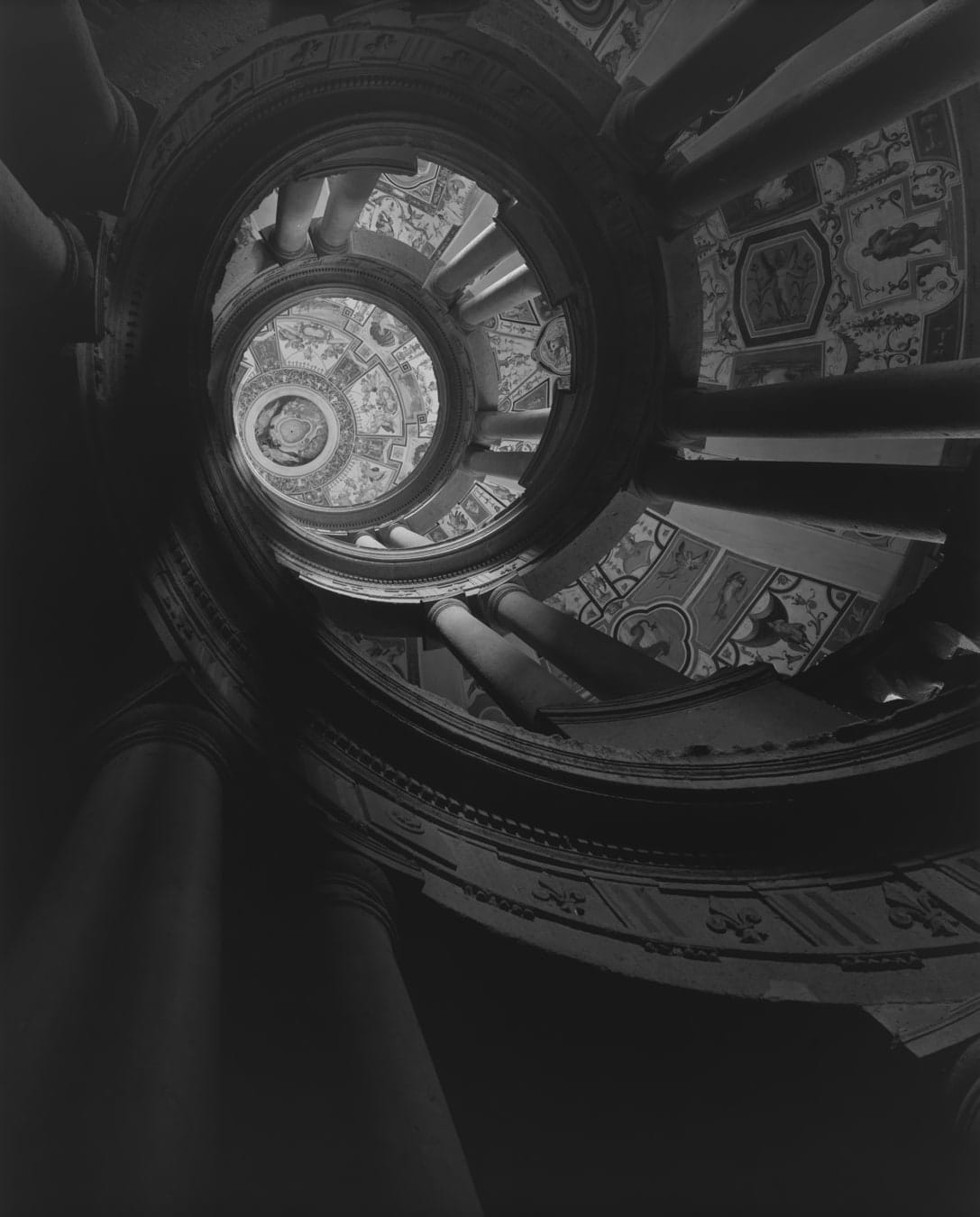
I chose this picture because it exemplifies Sugimato's two passions, photography and architecture. He chose a very neat angle. It appears as though he simply aimed the camera at a ceiling and took this picture, but it's clear that he put thought into the angle. He could have stood center in the room and took this same image and it would have been significantly less interesting. This angle provides somewhere for the eye to glide to. The line structure invites the audience to keep looking. The lighting in this image is also impressive. The shadowy lower half draws the eye up to the bright top, which highlights the designs on the wall along the way. I find his editing choice to make the image black and white interesting because I wonder if this ceiling has color. I feel as though I would have liked to see the way this ceiling was painted, I think that in this instance, that could have added to the image. Other than that, I think that Sugimato portrayed the architecture very well with this image.
Abelardo Morell
Abelardo Morell is a Boston-based photographer that was born in Havana Cuba in 1948. Morell is best known for his work with camera obscura.
I find this image of his particularly interesting. I appreciate that he combined the outside work with the indoors. This is a concept that I haven't seen much. I like that he chose to use a mostly empty room with only a desk, a chair, and a clock. With that choice, the reflection of the city is more apparent. If he had chosen a more busy setting, the image would have looked cluttered. The way the top of the city lines up with the top of the furniture shows artistic expertise and that he spent time to gets this photo to work. I think that the contrast of the city in whites and greys goes nicely with the silhouetted furniture. I am impressed that he was capable of getting all of the buildings from the outside, that makes the image look complete. If the buildings were on the ceiling, it would have taken away from the image. I think that overall, this image is very well done, and my favorite of his work.
Monday, April 19, 2021
Nikki S. Lee
Nikki S. Lee was born in 1970 in Geochang-gun, South Korea. She went to New York University, Chung-Ang University Anseong Campus, and Fashion Institute of Technology. She was well known for her work that involved attempting to assimilate into different social and subcultural groups. Different groups included: young punks, senior citizens, yuppies, and hip-hop fans. She would do this by mimicking their styles and mannerisms.
This photo is from Lee's Hip Hop Project. I think that this image is interesting because the depiction of "Hip Hop" can be seen through the subjects' fashion. The sunglasses and use of chains as necklaces and belts screams Hip Hop to me. The way the people are posing also seems to represent Hip Hop. All of their faces are nonchalant as if they're purposely not smiling, not trying to look happy. They look more dramatic than anything. I think the way that we can see a front car seats changes how a person views the image as well. I find it interesting that she chose to photograph them in a car, I'm guessing this is a choice Lee made, seeing as how the subjects are posing. It makes me wonder if a different setting could have gotten the point of "Hip Hop" across. Personally, I would have gone for a background of street art.
Thursday, April 8, 2021
Robert Frank
Robert Frank was a swiss photographer that was well known for photographing an outsiders view of America. He was born in Zürich, Switzerland on November 9th, 1924. He died in Inverness, Canada on September 9th, 2019.
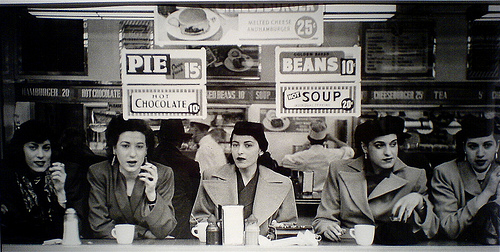
This image is from Frank's book The Americans. A reoccurring theme throughout the book is the use of American flags, and I don't care much for the flag as an American, so I decided to go with a more subtle image. I really like this one because all of the identifiable people in the image are women. Knowing that this series was taken in the 1950's, I would not expect women to be in the forefront of an image. The way they are lined up and the posture each person holds signifies empowerment. Each woman is also holding a different facial expression, but they all seem to be confident. This image appears to be candid, almost as if the women wouldn't stop what they were doing for a photographer. That makes me think that they were expressing that they value their time. I think that this image is a symbol of women's empowerment even if they were still treated as lesser than men.
Tuesday, March 30, 2021
Magnum Photography
Cornell Capa followed John. F. Kennedy around his campaign trail in the 1960’s. This is an image from the Magnum photos website (magnumphotos.com)
This photo is Kennedy accepting his nomination at the Democratic Convention in Los Angeles CA, 1960. This photograph portrays a significant role in history. Kennedy went on to win the presidential election and become the 35th President of the United States. For Capa to have been following him since the beginning was a smart choice. Capa captured all of the small moments leading up to Kennedy’s presidency. This photo is in black and white which brings the focus onto Kennedy’s face. There are no color distractions to keep the eye from going to Kennedy. He seems to be making a proud, but still taking in all in, sort of face. He’s sitting at a podium, but he doesn’t seem to be speaking. It appears that she’s just soaking in the news. It is likely he’s in front of a crowd, but he seems to be in his own mind. The signs with states and territories serve as a reminder that this is taking place in the US. I think that they also help to emphasize the importance of Kennedy’s presidential trail.
Monday, February 22, 2021
Richard Avedon
"The moment an emotion or fact is transformed into a photograph, it is no longer a fact but an opinion. There is no such thing as inaccuracy in a photograph. All photographs are accurate. None of them is the truth."
I agree with Avedon's statement because it becomes the viewers interpretation rather than simply what is seen through the camera's lens when the photo is originally taken. The accuracy of a photo diminishes as soon as the moment in which the photo is taken ends. New emotions are formed immediately after, new thoughts appear, changing the facts as they previously stood. I chose this photo because I think that it ideally portrays temporary emotion. This man has a very distinguished emotion on his face. I read it as pained, tired, wanting for a change. Others could easily read this emotion differently, making it a different emotion in their mind and therefore it is that emotion to them, not just the emotion that the man in attempting to portray in the moment that this photo was taken. Interpretation of a photograph changes the emotion and therefore the facts behind it. This photo accurately portrays the man's emotion, but there is no truth as to what that emotion is.
Wednesday, February 10, 2021
President Obama
This photo is iconic because it is not commonplace for a president to acknowledge his staff that does not directly communicate with him. I believe that this photo is an exemplar of the power of photography. Obama went out of his way to express his gratitude to a janitorial staff. If this were not documented as a photograph, a moment in which Obama's true kindness showed through, would not be seen by the world. If moments like this were not documented, Obama's reputation would be based on less little moments like this. Obama could have been seen as less kind and more inhumane if these moments were not documented. This could have shaped his entire presidency. If he has been less likable, he may not have gotten voted in for a second term. In his second term he did important things such as orchestrating the military operation that ended up being the reason that Osama Bin Laden was killed, and signing a major international climate agreement and an executive order that would limit carbon emissions.
Susan Sontag claimed that the context of a photo was very important. In this case, the context of this photo is that Obama is in the White House, as president, sharing gratitude for a worker doing an essential job that tends to go unrecognized. If this were Obama after his presidency in Hawaii, no one would really care. Because of his status, Americans eyes were on him at the time that this happened. That makes this photo more significant. This photo was most widely seen on the internet, which means it reached a large group of people. This gave fans of Obama the chance to boost this photo and get it even farther than it would be seen if it were just in a magazine or newspaper.
Wednesday, February 3, 2021
In Platos Cave
"Photographs, which fiddle with the scale of the world, themselves get reduced, blown up, cropped, retouched, doctored, tricked out."
I think that this is an interesting point because it explains how a photo seldom stands alone. A photo is usually edited in some way before being presented to the world. Photographs tend to care more about whether or not their audience is pleased with the image than the integrity of the image itself. I think that in a lot of cases an unedited image can be very powerful, even if it isn't the most appealing to an audience. I think that photographers should take more time to consider whether or not it's a good idea to edit a photo. Plenty of photos could stand alone without the editing. I understand if there's a technical issue with the image, or if the image would look better with more saturation, but for most photos the appeal is in the illusion of honesty.
"Thus, photography develops in tandem with one of the most characteristic of modern activities: tourism. For the first time in history, large numbers of people regularly travel out of their habitual environments for short periods of time."
I find this quote to be interesting because I never considered the effect that photography had on tourism. I think it's interesting that one form of art can influence people to spend large amounts of money to travel somewhere. I do understand it though. People see a bright, pretty, place and think "I want to be there." I just never considered that where people vacation and spend their time could be so heavily influenced by photography. I do also think it makes sense that tourism grew in tandem with photography. The unknown scares people, so when they got to see what all of these places looked like, they were willing to drop the money on going in person.
"Thus, in the bureaucratic cataloguing of the world, many important documents are not valid unless they have, affixed to them, a photograph-token of the citizen’s face."
Another thing I hadn't considered before is how photography has become a tool to catalog the world. Photos have become such an important form of identification that they are ingrained into everyday necessities. It's even gotten to the point where technology-such as phones can identify us by our faces. I think because I was born in 2000 I never experienced a world that wasn't ruled by photo identification. I honestly can't imagine it. Photos are on drivers licenses, social media pages--which work as sort of diaries now a days with how people post their feelings and achievements on them, and any other place where self identification is. Photos are used on the news if a person is missing or in trouble with the law. Everyone has photos of themselves on hand. It's strange to think that self-identification could mean something other than a photograph.
Monday, December 7, 2020
Final
“Beautifying is one classic operation of the camera, and it tends to bleach out a moral response to what is shown.” (P64) I chose this sentence because while she goes on to talk about active response in terms of shock value, I originally interpreted this sentence to mean pictures of people and how they react to seeing an image of themselves. It got me thinking about how people expect a camera to magically make things look good, even if the origin of the photo isn’t beautiful. There is an unspoken expectation from the subject of the photograph that the things the don’t like simply won’t show up in the picture, but that’s not the reality of photography. Photography captures the raw truth of a moment, whether it’s beautiful or not.
“I argued that while an event known through photographs
certainly becomes more real than it would have been had one never seen the photographs,
after repeated exposure it also becomes less real.” (P82) I found this quote to
be very impactful. I was inspired by the way she eloquently expressed how I feel about the matter as well. I know she was responding to this belief because it was one she had years before, but I think that it is an appropriate belief for the question of whether exposure of an image determines value of an image. It loses its initial reaction after you've seen it enough times.
"That news about war is now disseminated worldwide does not mean mat the capacity to mink about the suffering of people far away is significantly larger." (P90) This is why I believe that images of cruelty should not be censored. Not everyone is exposed to the cruel environments that people in other countries live in. Just because news spreads faster and farther now, doesn't mean that we are getting the news of the troubles of other countries. This form of media hides and monitors things that could potentially scare away viewers rather than just showing what's going on in the world. I think that every person should have an opportunity to understand what its like to live as a person that is less fortunate than them, and this can be done through photos. A person can be exposed to the harsh realities that unfortunately do exist.
3. Answer
each of the following questions:
- What is this obsession and fascination with
the depiction of crime, pain and horrors,
bordering on voyeurism?
Are we becoming immune to shock or at least being
desensitized
over time? Do people want to look at horror or even get pleasure out of it?
I think it stems from a concept that Sontag mentioned about
how these types of photos invite a person in, it gives them the option to
either be a spectator or a coward. And over time we become desensitized because
we detach ourselves from what is going on in these depictions. People want the possible
satisfaction of knowing. (p73)
- Has our society
become anesthetized by and is apathetic to the horror depicted on a
daily basis on
TV and in the social media?
Yes.
- Does our incapacity to deal with distant events of horror leave us
indifferent when we are not
directly affected by them?
Yes.
- Why do people post images of cruelty
online for the whole world to see and think they
can get away with it? For example, in
2013, two high school football stars from Ohio posted
a video on YouTube of the rape of a
drugged and unconscious girl. When the crime
came to light, it split the town in half
between people defending the players and others
who wanted them to be prosecuted. There
is a screenshot in the picture section below.
Sontag quoted Shakespeare in saying
that the reason that people were attracted to the villainy on stage during his
plays was the “love of mischief,” or as Sontag interpreted it, “love of
cruelty.” She said it is as natural to human beings as sympathy. (p77) I think
that a part of the boys didn’t see that there was something wrong with their
actions (and therefore did not think that there was any reason for them to be
punished) and since they enjoyed doing it, they thought people would enjoy
watching them do it.
- American soldiers photographed the
torture and humiliation of Iraqi prisoners at the infamous
Abu Ghraib prison, and then passed the
images amongst themselves. These pictures seemed
to the soldiers nothing more than boys
and girls having fun, or as the radio personality Rush
Limbaugh said: “You
know, these people [the US soldiers] are being fired at every day. I’m
talking about
people having a good time. You ever heard of emotional release?” What do
these images
say about empathy, power and humanity? Look
at the images of Abu Ghraib.
These images show that it is possible to operate without a
sense of empathy. These soldiers tortured people without wondering if there was even
an inkling of decency in the prisoners. These war prisoners were tortured because
some soldiers didn’t care about other people’s lives. They held power over
them. They caused other people pain in order to show off their power. I think
that the soldiers were so far beyond desensitized that they had lost their
sense of humanity.
- What is the
role and responsibility of the photographer in taking and disseminating
images of war
and cruelty? Do they need to censor how and what they photograph?
Look at the
images by Robert Capa, Eddie Adams, Nick
Ut, Susan Meiselas, Richard
Drew, Ron Haviv, Kevin Carter, Alan
Kurdi, James Nachtwey.
I think that photographers should not censor what or how
they photograph. I think that there is no way to fix a problem that you don’t
know exists. It may be harsh but those types of photographs educate people from
areas that don’t have the same problems that these issues exist and need
attention too. I think that the role and responsibility of the photographer is
to take the pictures of war and cruelty, not to appease an audience, but to
educate an audience.
- The great photo journalist Sebastião
Salgado has often been accused of producing
“spectacular,
beautifully composed pictures” of misery that were aesthetically too pleasing
to
give the
subject matter its full weight. Does somebody like him need to forgo his
style and
create
conventional looking photographs? Look
at the Salgado images.
I think that he can have his style and continue with it
because that is how some people handle viewing misery, they aren’t bold enough to
take on viewing pictures like Kevin Carter and Alan Kurdi took. His glamorized
versions of misery still portray misery. I think that since this is his
signature style, the viewer knows to expect the image to not be carrying the
full weight of the issue portrayed.

Tuesday, November 24, 2020
Irving Penn
Irving Penn was an American photographer born on June 16th 1917 in Plainfield, NJ. He passed on October 7th 2009 in Manhatten, New York, NY. He had an extensive career working with Vogue Magazine and won the Hasselblad Award.
I chose this photo because it is similar to the style of photos that I was trying to take. It has vast expression, even in the body language. Her face says so much without her having to say a word. And her slanted back posture defends the statement she is silently making. To me, she is exerting "you did this wrong" sort of vibes. I chose Irving Penn to inspire my self-portraits because of his experience in studio taking images. I wanted to capture the glamour and intrigue that Penn captures in all of his images.
Thursday, November 19, 2020
Judy Dater
Judy Dater is an American photographer. She was born on June 21th 1941 in Los Angeles, CA. She has won the Guggenheim Fellowship for Creative Arts, US & Canada.
The inspiration for me choosing Judy Dater was her photo essay in which she portrayed the roles as a woman is supposed to play in her pictures. I did a similar thing in which I portrayed how college student are and are expected to be, but I also decided to add a panel of what results of these expectations placed on college students.
Wednesday, October 28, 2020
Alessandra Sanguinetti
Alessandra Sanguinetti was born in 1968 in New York, New York. She is a member of Magnum Photos. She has received multiple awards and grants, including the esteemed Guggenheim Fellowship.
I think that this photo is absolutely beautiful. The emotion expressed by this image can be seen through the usage of nature to exemplify the age of this girl. The leaves taped to her nails show a want to be old enough and mature enough to have long nails. This could also be seen as the societal pressure pushing a young girl to grow up so quickly. Another example of this in the image is the flower in her mouth and the way she is pursing her lips to make it look as though the flower is acting as a cigarette. I think that this photo shows a powerful message that is well portrayed. I also think that depth of field is used to discourage distraction from the message that Sanguinetti is trying to show. She chose to have only the child in focus and no part of the background. I think this helps to draw the audience to the child's face and action (of pretending to smoke a cigarette) which helps to enhance this image.
Thursday, October 15, 2020
Yousuf Karsh
Yousuf Karsh was an Armenian-Canadian photographer. He was an Armenian Genocide survivor, then he migrated to Canada as a refugee. He was born on December 23rd, 1908 in Mardin, Turkey. He died on July 13th, 2002. His work was highly regarded and he was considered by some to be one of the greatest portrait photographers of the 20th century.
I love this photo because it screams regal and she isn't even smiling. She doesn't have a courteous queenly reaction to having her picture taken, so although I know this is staged, I like that she isn't sitting straightforward and smiling, like I would expect a queen to be. Instead she is looking over her shoulder with a straight face. I like that this photo is black and white, it gives the viewer a chance to see the model without the distractions that the element of color can bring. Without color, there is more focus are her smug expression and pointed posture. I think that everything from the angle to the outfit make this a stunning picture.
Tuesday, October 13, 2020
Annie Leibovitz
Annie Leibovitz is an American photographer. She was born on October 2nd, 1949 in Waterbury, CT. She often takes pictures of celebrities.
I particularly like this photo because it is inspired by the Disney animated movie Brave. This is a movie that I loved as a kid and still love now. Leibovitz did a great job with it because I was immediately able to identify that this was supposed to be inspired by that movie upon first glance at the picture. I think that the costuming helps to show the culture that meant to be portrayed (Scottish.) I think that the contrasting between the grey clouds, the silky black horse, the green velvet dress, and the model's orange hair ties together perfectly to set a mood of fierce but still fairy tale-esque. Even the expression on the model's face brings so much to the picture. She seems to have a smug confidence, it makes me think that she can do anything. Another element that plays well into this picture is texture. It looks as though the viewer could touch the horse and the dress. I think that Leibovitz did amaxing with this photo, I don't think that there is any way that this image could be improved.
Fred Ritchin
"The digital photograph also can be said to represent a single moment, but one that can be easily lengthened and amplified by joining it to many moments through various forms of hyperlinks and hybrid media, including extending it as a movie."
This quote is important because it shows the complexity to digital photography. It provides an example as to one of the ways that a single photograph can be manipulated into so much more than just a singular moment.
"The contradictory "double image" is cubist; reality has no single truth."
I just thought that this quote was interesting. The idea that a photo is more than just what is in the photo is interesting to me. I like the concept. Every photo can be more than what it is made of. A picture could be of an open window but really be trying to symbolize the freedom of the mind. I think that it is fascinating to think that there can so much meaning hiding in one image.
"Rather than be rendered passive and guilty from the latest shocking photograph or suffering from a terminal case of compassion fatigue, the reader could be given a chance to intervene."
I think that this quote is important because it exemplifies the advances made in technology. Technology has made photography so much easier to locate and consume. Now people can just access art online and enjoy it in their own homes. This has also left art more vulnerable to criticism by people who may or may not be educated to place judgement. Artist are also more able to share the message behind their art with these technological advances. I would say that the advances in technology come with their perks and drawbacks.
Thursday, September 10, 2020
Uta Barth